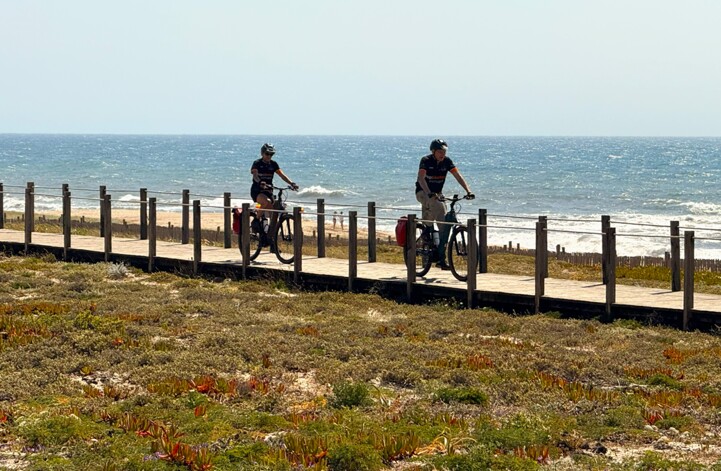
This stage is located to the west of the Iberian Peninsula. The basis of this tourist route is a Roman road that started to be built in the 1st century BC and eventually became one of the main roads linking the north and south of the peninsula. Along the route, you will find some of the most important archaeological sites of the Roman period as well as monuments dating from later periods. Ruta Vía de la Plata allows you to cross Spain from north to south. It is more than 500 miles long, passes through 4 autonomous regions (Andalucía, Extremadura, Castilla y León and Asturias) and 7 provinces, where you will discover settings with numerous historical, natural, cultural and gastronomic attractions.
PUBLIC TRANSPORTATION IN EUROVELO 1 - ANDALUCÍA
SUMMARY
Bordering Portugal and bathed by the Atlantic Ocean, Eurovelo 1 in Andalucía, is located
in the province of Huelva, the westernmost of Andalusia. Bordering the province of
Badajoz to the north, and provinces of Seville and Cadiz to the east, the Atlantic Ocean
to the south, and Portugal to the west. The capital of the province of Huelva is the City
of Huelva.
From the westernmost foothills of Sierra Morena to the Atlantic coast, travelers
exploring the province of Huelva, will enjoy bountiful and delicate natural landscapes
beneath bright blue skies.
The mountain climate is warm and mild, and tempers the high summer temperatures and
the rigors of winter. The center –warmer and drier– is cooled in the evening by sea
breezes.
The temperate climate on the coast is perfect for enjoying the sun and the sea all year
round, in a landscape dotted with inviting white villages, equipped with all modern
amenities.
Visit Huelva, discovering two of its main Protected Natural Spaces. The Sierra de
Aracena and Picos de Aroche Natural Park, whose landscapes of "Dehesa" are
Biosphere Reserve. Doñana National Park is a mosaic of ecosystems that hosts a
unique biodiversity in Europe.
By bike, the province of Huelva allows you to enjoy the integrity of its varied and beautiful
landscapes, full of culture and high level gastronomy. From the Sierra de Aracena and
Picos de Aroche, a very rainy area, bordering for centuries, full of castles and villages
protected by their beauty, to the rivers Tinto and Odiel. The journey should finally take us
to Doñana and the Atlantic Ocean, kingdom of hundreds of species of birds, marshes,
eagles and lynxes. The Guadiana and Molinos del Agua greenways lead cyclists through
two other regions, both mining areas, always next to rivers. Huelva has everything and
everything good, as you will see when you get off your bike and have lunch.
Eurovelo 1, the Atlantic Coast Route, ends its Spanish journey in Andalucia, covering a
final 230 kilometers that extend from Higuerra de la Sierra to Ayamonte. In the north,
mountains will be the star attraction leading down to grasslands where you should be
sure to taste the local cuisine. Continuing south you will see the Mars-like landscape of
Riotinto’s mining zone. The itinerary continues along the Columbian sites and the city of
Huelva, before reaching the Atlantic coast with its sandy white beaches.
Tips and recommendations
- Respect the layout of the routes. An unsecured shortcut can lead you astray or put your safety at risk.
- Enjoy the silence and do not disturb it. Listen to the music of nature. Inform someone of the route you plan to take.
- Calculate the time you will spend and avoid getting dark at evenings.
- Read information or visit the visitor center to find out what you will see.
- Calculate your rhythm according to the total distance you plan to walk.
- Check the weather forecast and be prepared for rain or cold.
- Take water and some food with you.
- Be cautious, particularly in areas with traffic and when the track has more users such as hikers or horse riders.
- Local people are often a generous and interesting source of information. Live with both nature and them.
More info at www.turismohuelva.org
PUBLIC TRANSPORTATION IN EUROVELO 1 - LA RIOJA
La Rioja's landscape allows cycling tourists to enjoy its vineyards, monasteries that are UNESCO World Heritage Sites, the Camino de Santiago and all its stunning diversity.
By train:
You can travel with your bicycle on all trains. Your transport depends on the type of train.
More info at: https://www.renfe.com/es/es/viajar/informacion-util/equipajes/bicicletas-y-patines
Bus:
You can travel with your bicycle on the intercity bus. They must be disassembled (at least the front wheel) and packed (in a cover or bag), in order to take up as little space as possible. One bicycle per passenger is allowed. More info at: https://www.larioja.org/transportes/es/interurbano/horarios-frecuencias-lineas-transporte-interurbano-rioja